Showing posts with label Wellness Wednesday. Show all posts

Wednesday, May 8, 2013

Exercises That Reduce Stress

What better way to unwind and/or start your day right than to engage in some exercises that are known to relieve stress? You are probably already aware of these types of exercises; in case you need a refresher and a reason to engage in their benefits, listed below are the types of exercise along with their stress-relieving qualities.

If you haven’t signed up for a yoga class, it might be a good idea to check out your local gym. Yoga is proven to improve focus, reduce blood pressure. It helps you practice new postures that enhance concentration and promotes relaxation through deep breathing techniques. Ashtanga, vinyesa, and Bikram are more athletic varieties, while Hatha yoga is more easygoing and focuses more specifically on reducing stress.

Tai Chi is a type of exercise that involves focusing on the present moment while enhancing flexibility and improving mood. It involves a meditative focus and connects types of physical exercises to specific breathing patterns. It also is known to improve balance, promote better sleep and enhance cardiovascular functioning. In contrast to yoga, there are no pauses between poses. It is similar to yoga in that the exercises vary in intensity.

Qigong is another type of exercise that is similar to Tai Chi and Yoga that incorporates very slow movement with associated breathing patterns.

Walking on a regular basis can not only reduce stress but also improve your confidence in your sense of well being. It releases muscle tension and relaxes breathing. It is recommended that you start with two 10 minute walks; then, gradually increase your walking duration to five or six 30 minute walks. Frequent walking can lower your risk of diabetes, cardiovascular disease and lower your cholesterol.

Pilates is a series of exercises that focuses on alignment and lessens back and neck pain. It is similar to yoga as it focuses on performing the exercises while living in the moment, thereby reducing worry.

Tennis is another useful exercise and sport for reducing stress since it has the added bonus of working with a partner and therefore keeps you socially connected. It is also great for your cardiovascular system; additionally, this sport stave off heart disease and high blood pressure.

For more information on this topic, visit this link.

Wednesday, December 12, 2012

Dealing with Holiday Stressors This Season

Traditionally speaking, we all know that the holidays are time of active celebration. Hopefully, you are looking forward to a festive and fun holiday season this year. You are probably also aware that the holidays can be a time of stress and overindulgence (i. e., holiday parties) in a way that might make you feel lethargic and drained. Below are some common holiday stressors and methods of combating their effects:

• Prevent burnout from overbooking yourself for too many party obligations and the pressures of holiday shopping. Use a post-it note or a journal to write down your purpose for this holiday season and create meaning during this hectic time of year. For example, maybe you want to bring some comfort and meaning to someone who is going through a difficult time or engage in volunteer work for those who are less fortunate. It could be something very simple such as giving a compliment to someone every day or making at least one new friend during the holiday season.

• Set boundaries for yourself prior to holiday events to prevent overindulgences and negative habits. The holidays, parties especially, can trigger overindulgences that we might otherwise have in check most of the time. Having an internal awareness of our past weaknesses will help set goals and develop strategies to overcome them this season. For example, if you tend to overeat starchy foods and sweets at parties and feel drained and exhausted afterwards, having a light snack before the party may help you tame this urge. Or, if you tend to overspend from holiday sales and gift shopping, create a budget ahead of time and a monetary figure that you will not exceed. A good tip is to make a list of all of the bad habits from previous holiday seasons and next to each one, a coping strategy to prevent negative consequences.


• Spend time reflecting (e. g., by recording in a journal) on what you need emotionally, mentally, physically and spiritually to feel healthy and strong. It may be to stick to certain dietary guidelines by getting more protein and fewer starches to maximize your energy. Or, it may be to spend time with a friend or support group once a week as a way of feeling a deeper sense of belonging.


• Make it a point to spend time with a good friend or supportive relative to prevent feelings of loneliness and isolation that sometimes surround us when we are away from close relatives that live far away.


• Keep an open mind and set out to achieve connections and insights to combat succumbing to stressful and overwhelming feelings that this time of year can sometimes bring. Set out to make some new connections with positive people or to strengthen an existing relationship in your life. Additionally, train your thinking to anticipate positive surprises rather than dwell on the stressors that sometimes come with family gatherings and holiday commercialism.


• On a daily basis, find at least one thing, person or situation that you are grateful for and make a mental note or jot it down. Make it a goal to record a minimum number of things to be grateful for in a “gratitude journal”.


Overall, by looking at last year's overindulgences and the triggers that can lead to holiday burnout, you can develop new strategies for creating meaning during this time of year.


For more information on this topic, visit this link.

Wednesday, October 10, 2012

Why Bother with Breakfast?

Many busy students may be tempted to skip breakfast for a variety of reasons.They think it will add too much unnecessary time to their morning routine, they don’t feel hungry first thing in the morning or they think that skipping meals can improve weight loss. In reality, a healthy breakfast can be quick and easy, will help jumpstart your metabolism for the day and give you the energy necessary to get your morning off to a productive start.

You may be wondering if you can squeeze breakfast into your already hectic morning schedule. It’s not as hard as you might think. Make it part of your daily routine. Every day you plan accordingly for the days activities, squeezing in an extra ten minutes each morning for a healthy breakfast will pay dividends and will be well worth the investment. In fact, research indicates that students who ate breakfast prior to taking a test did better than those who did not.

If you aren’t a big fan of traditional breakfast foods check out these examples of quick, inexpensive and healthy breakfast options recommended by other college students.

Wednesday, December 7, 2011

How Well Do You Know Your Nutrients?


How well do you know your nutrient terminology (e. g., Anthocyanidins???). Test your knowledge of nutrients and which foods contain them by taking this quiz.

Wednesday, November 30, 2011

Too much to do? Tips for managing stress

It is natural for students to feel greater stress as the end of the semester approaches. In the beginning and middle of a semester, assignments tend to be smaller and evenly spread out because you are in the early stages of learning the material. As the course progresses, eventually there will be a project or paper where students need to apply what they have learned in some way. These assignments are often more challenging or complex than the early assignments. In addition to that, there are exams to prepare for, often in several classes at once.

Surprisingly, stress is actually a very healthy thing for us. Without stress, our lives would be filled with constant procrastination as very few things became important enough for us to actually do. Stress is what drives us to complete the projects and assignments and study for the tests. If too many stressors build up, however, it can sometimes make you feel sick physically. If this happens to you, there are several strategies you can use to manage it.

First, making a list of all of the things that are causing you to feel stress can be stressful in itself to draw up, but doing so will help you create a clear picture of what is weighing you down. Once you have the list, organize the list by importance, but try to weave easy-to-do tasks from the list between major tasks so you can gain a sense of quick ‘relief’ from a stressor by doing one of the easier tasks when you need a quick burst of energy or sense of accomplishment. Break the larger tasks down into smaller bites that are easier to handle. If something is causing an enormous amount of stress compared to everything else on your list, try to tackle that first—it will make doing everything else that much easier.
Make a list of soothing activities that help you relax. Do a soothing activity between each of the items on your list to give yourself recreation and mental breaks. Don’t forget to exercise, eat healthily, and get a normal amount of sleep whenever possible. Those habits will help your body be more resilient to stress whenever it occurs. Finally, remind yourself that this stressful time will not last forever. It will only be a few short weeks before you can take a nice relaxing break between semesters!

Wednesday, October 19, 2011

Techniques for Clearing Your Mind of Stress and Clutter

With all of the busy activities that we engage in every day, it is easy to get burned out very quickly as a result of a clutter-filled mind of thoughts and to do lists. Every now and then, it is important to engage in activities to help release stressful thoughts:

  • Go for a nature walk during a time in the day when you are most refreshed and have no long term responsibilities. Use the time to clear your mind and let your thoughts flow in and out of your head. With each thought that causes you anxiety, learn how to gently release it.

  • Call a friend and talk out the issues that are causing you concern and find some common ground. This will help you gain perspective on things that are causing you distress and get some positive energy from a good friend.

  • Hugging a pet or family member can release calming chemicals in our bodies and relax us from the stress.

  • Record your disappointments and goals in a journal. Getting it out on paper is a useful way to release mental clutter.

  • Do something you are passionate about. Whether it is singing or performing, drawing or sewing, engaging in an activity that you love can keep you focused on one task rather than letting your mind get lost in scattered thinking.

  • Be a risk taker. Try an activity that you have never engaged in such as karaoke or parachuting. It will awaken your heart and mind and promote focus.

  • Exercising releases endorphins to help further calm your mind

  • Find humor in situations that may be causing you to take life too seriously. By learning to laugh at ourselves, we release feel good chemicals that get suppressed when we worry.

  • Create a mood board by cutting out pictures and articles and creating a collage and create a work of art. This is a creative way to release mind-cluttering thoughts while seeing things from an artistic viewpoint that you created.
For more information on this topic, visit this link.
Wednesday, October 12, 2011

Stuck in a Rut? Check out these Coping Strategies

It’s that sinking feeling that you know things aren’t moving in the direction you want to go and things have been at a standstill for way too long. Perhaps you feel that you made the wrong career choice, have too many responsibilities on a constant basis and no time to recuperate, your house is up for sale, but not selling due to too much competition. Whatever the reason, we’ve all been there and sometimes, all we need is to remind ourselves to be gentle with ourselves in the same way that we are kind to others.

• Where you can, find ways to extend deadlines. For example, if you have a work or school project that in your mind, you would like to have done in a week, but you have 3 weeks to complete it, give yourself an extra day or two and remember to take time out for yourself.

• Lower your standards and make your goals attainable. If you are not feeling like the Energizer Bunny and you set your intention to write 2 essays in one day, when you have a period of a month to complete them, narrow your goal down to, "I will complete 2 paragraphs of my rough draft today of my first essay."

• Help someone else. Whether it’s volunteer work or being a good listener, helping someone helps us feel reconnected and assured that we are not alone in our struggles. Not to mention, it can take our mind off of the “in a rut” feeling that can make us feel isolated.

• Find your symbol of inspiration. Whether it’s gardening, spending time with your cat or dog or listening to a song that inspires and motivates you (I like to belt out “Cool Change” by Little River Band!), whatever gives you inspiration will help give you the hope to keep going.

• Surround yourself with positive people. People that give you a happy, positive feeling, be it good friends or family can keep you upbeat in down times.

• Develop an inspirational mantra such as “How can I be less affected by this?” or “Today, I will gather knowledge that I didn’t have yesterday about reaching my goals.”

• Review your past successes. Look back at a time when you won an award or were shown appreciation, respect and praise for something that showcased your inner most talents. Imagining yourself in this situation and going back in time will help you recapture the energy that keeps you moving forward toward future successes. Begin with the end in mind and use that energy to stay on course toward that destination.

Always know that being stuck in a rut is a temporary situation and using this time to be extra gentle with yourself is a great way to come to some new epiphanies about what you really want from your life at this time as it relates to personal, academic and professional growth. For more information on this topic, visit this link.

Wednesday, October 5, 2011

Disability Support Services for ELI Students

NOVA’s disability support services are not limited to traditional on-campus students; ELI’s on-line students may also request appropriate accommodations for documented disabilities!  Perhaps the best way to start the inquiry or request process would be to contact ELI’s Disability Support Services (DSS) Liaison, David Highsmith.  David is one of ELI’s counselors, and he is available to address general questions you may have about disability support services; he can also walk you through the process for requesting accommodations at NOVA.  You may reach David at dhighsmith@nvcc.edu or 703-323-2404. 
Another great source for information on disability support services at NOVA is the DSS website.  After carefully reviewing pertinent portions of this website, check-out the “Students with Disabilities Intake Packet” link in the “How to Begin” paragraph.  Please note that the intake packet (and supporting documentation) must be processed through one of NOVA’s six campus-based DSS offices – and you’ll find contact information for all six offices directly below the “How to Begin” paragraph.

Wednesday, July 13, 2011

Wellness Wednesday: Farmer's Market


Earlier this summer, Parade Magazine created America’s Bucket List 2011 and lists “Visit a Farm” as number 3 linking readers to Local Harvest.

According to local farmers, the best organic food is what’s grown closest to you. This website is a great resource to learn about local farms in your area, or an area you are traveling to throughout the summer. This is a great way to support local farmers, as well as provide farm fresh food for you and your family.

Whether visiting a farmers market is on your summer bucket list, or you are a regular at your local market this website will provide you with a wealth of knowledge on local farms.

Have fun and explore.

Wednesday, July 6, 2011

Vacation Wellness Tips

While we plan for our summer vacations and prepare for some much needed relaxation, it’s easy to neglect important health issues as we bask in the glow of the sun and our downtime. Below are some tips for staying happy and healthy while traveling this summer:

• Avoid drinking water from suspicious sources such as lakes, rivers, pools and back-country streams. You may be tempted to drink water from these sources while camping in the woods. However, be aware that this water may contain Giardia, a tiny parasite that can cause gastrointestinal distress that includes vomiting, cramps and nausea. Boiling water for 10 minutes or more can kill the parasite. Packing plenty of bottled water is another way to stay hydrated while avoiding potential parasites from suspicious sources.

• Food poisoning is one of the most common illnesses that affects over 50,000 people who travel in the US and overseas. Eating contaminated or spoiled food causes food poisoning so think twice before devouring that sandwich that has been sitting out for several hours. Some tips in avoiding food poisoning include: cooking meat and fish sufficiently and making sure the fish is hot and cooked through when served. When traveling, it is a good idea to stay away from unpasteurized milk and milk products as they contain heavy amounts bacteria. Since bacteria quickly multiply at lukewarm temperatures, it is wise to consume foods that are very cold or hot. It is also a good idea to avoid buffets since it’s hard to know how long it has been sitting out or who is coming into contact with the food.

• Bug bites can lead to Lyme disease (in the case of a tick bite) or the West Nile virus so it is best to avoid grassy areas in the early morning and early evening hours when these critters proliferate. It is also a good idea to wear long sleeves and long pants when walking in the woods to avoid bugs from getting on your skin. At the end of the day, be sure to check for bugs prior to changing your clothes. Do not go up to stray animals to avoid the risk of Rabies.

• Getting too much sun can present another potential health hazard when traveling in the summer heat. Overexposure to the sun is the culprit behind 90% of wrinkles, fine lines and sun spots. To avoid the dangers of too much sun exposure, use a sunscreen that contains a minimum SPF of 15 and wear sunglasses that block 100% of UVA and UVB rays. The most severe form of UVA damage occurs between 10 a.m. and 4 p.m. so use extra sunscreen at these times.

• Prevent rashes by avoiding common plants that harbor triggers such as poison ivy, poison oak and poison sumac. These plants release a chemical called urushiol, an oil that produces rashes, bumps or blisters even in small amounts. These plants can be found in forests, fields and on the side of streams. Should you develop a rash, use calamine lotion, hydro-cortisone cream or special creams that are used in the treatment of these skin conditions.

Armed with these techniques to prevent contracting summer illnesses, you are on your way to happy and healthy vacation!

For more information on this topic, visit this link.

Wednesday, June 22, 2011

What Do You Put on Your Plate?

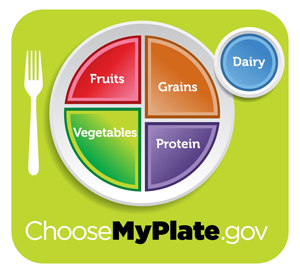
Earlier this month First Lady, Michelle Obama, introduced a new concept for healthy eating. Gone is the old pyramid that we all grew up with where bread, cereal and grains created the base of the pyramid, followed by fruits and vegetables, meat and dairy and topped off with fats and sweets. The government has now issued a new image of what we should look for in a healthy diet. Instead of trying to guess how much fat and sweets would make up the cone of the pyramid, we can use our own dinner plate as a guide!


According to choosemyplate.gov half of our plate should be filled with fruits and vegetables and the other half includes grains and proteins. Check it out for more details. Not sure how your diet measures up? mypyramidtracker.gov will analyze your diet for you.

So why should we care what we eat? Many studies have shown the connection between diets and the ability to learn and concentrate. According to Fernando Gómez-Pinilla, professor of neurosurgery at UCLA, “Diet, exercise and sleep have the potential to alter our brain health and mental function.” And we all know that top mental function is important when taking classes!

So next time you sit down to dinner, take a look at your own plate. How well does it match the new guidelines?

Wednesday, June 8, 2011

Wellness Wednesday: 10 Stress Busters


Want a better way to stay well? DE-STRESS

Therese J. Borchard suggests these ten ways to de-stress in her article

1. Simplify: Cut your to-do list in half. If you were to die tomorrow, what can you live with not accomplishing today?

2. Prioritize: Identify what is most important rather than being at the mercy of trivial matters such as random text messages. Or, things that matter most should never be at the mercy of things that matter the least.
3. Use Pencil, Not Pen: Stay flexible to change and don’t be afraid to make mistakes!   A wise man once said, “that’s why pencils have erasers!”

4. Give Away your Cape: Surrender to limitations and conditions such as sacrificing a good night’s sleep to accomplish 4 additional loads of laundry.

5. Collaborate and Cooperate: Realize that others have to-do lists very similar to yours, work with them to help not only yourself but each other. 

6. Laugh: Humor can heal. Laughter can also boost the immune system and has been found to boost a person’s ability to fight viruses and reduce stress hormones in the body. 

7. Exercise: Exercise relieves stress in a number of ways.  (Releases endorphins which calm the mind and buffer against stress, helps to maintain metabolic functioning as we age and combat the chemical changes that stress induces).

8. Stop Juggling: By eliminating your habit of multitasking, you will decrease your stress.  While multi-tasking is a great buzz word in the workplace, in our own personal lives, it can lead to scattered thinking if we are constantly doing this.

9. Build Boundaries: Designate a place and time for certain things so that your brain doesn't have to wear so many hats at the same time. Don’t be afraid to assert yourself by saying “no” when the situation warrants it. For example, if you can’t attend a friend’s party in a week, affirm her invitation by showing gratitude, explaining that you have certain priorities you must attend to, but you will gladly attend the next
one!

10. Don’t Sweat the Small Stuff: Most of it is all small stuff.  Feel free to check in with yourself every now and then and tell yourself “I’m taking this too seriously.”  You’ll quickly move on to bigger and better things rather than endlessly ruminating about something you can’t change or isn’t that important in the first place.